Fuel is one of the largest and most complex costs any fleet operator faces, yet it remains one of the least systematically managed. For businesses running vans, lorries, or mixed fleets across the UK, fuel typically accounts for 30 to 35% of total road freight running costs. Despite this, many operators still rely on rough estimates, paper receipts, and gut instinct rather than structured tracking. This guide cuts through the confusion by providing concrete, number-based examples of business fuel expenses, explaining what HMRC allows you to claim, and showing how to use that knowledge to reduce your overall spend.
Table of Contents
- What counts as a business fuel expense?
- Real-world fuel expense examples for common business vehicles
- How HMRC fuel rates and VAT rules shape your business claims
- Ways to reduce business fuel expenses and boost efficiency
- A practical perspective: why business fuel management is about more than receipts
- Fuel card solutions to simplify and save
- Frequently asked questions
Key Takeaways
| Point | Details |
|---|---|
| Know your fuel costs | Fuel can account for up to a third of fleet running costs, so tracking it precisely is vital. |
| Use HMRC rates wisely | Leverage Advisory Fuel Rates and accurate mileage logs to claim the right amount and simplify tax compliance. |
| Benchmark and optimise | Compare your spend to sector norms and use technology and route planning to drive down fuel expenses year by year. |
| Take control with fuel cards | Fuel card solutions help recover VAT, automate reporting, and add transparency—making fuel management easier. |
What counts as a business fuel expense?
Before you can manage fuel costs effectively, you need to know exactly what qualifies as a business fuel expense under UK rules. The category is broader than most people assume, and getting it right from the start saves significant administrative effort later.
Fuel for business journeys is the obvious starting point. Petrol, diesel, and alternative fuels used in vehicles travelling for business purposes are all claimable. The key word is "business." Commuting from home to a regular workplace does not count. Travelling between client sites, to depots, or for deliveries absolutely does.
Electric vehicle (EV) charging costs also qualify, and this is an area growing in importance as more fleets electrify. HMRC has introduced the Advisory Electricity Rate (AER) specifically to handle this. Understanding how fuel card expenses work across both traditional and electric vehicles is increasingly important for modern fleets.
Here are the core categories of qualifying business fuel expenses:
- Diesel and petrol for company vehicles on business journeys
- LPG and alternative fuel costs for qualifying vehicles
- EV charging costs at home or public charge points for business miles
- Fuel costs reimbursed to employees using their own vehicles for business travel
- VAT on fuel, where proper records are maintained
HMRC rule to remember: You can reclaim VAT on the business portion of fuel, but only if you hold valid VAT receipts and maintain accurate mileage logs. VAT is reclaimable on the business fuel portion using Advisory Fuel Rates (AFRs) to separate the fuel element from the total mileage rate. Without those records, you cannot make a valid claim.
The separation of personal and business fuel use is where many businesses fall short. If a driver uses a company vehicle for personal trips as well as business, you must apportion the fuel accordingly. Keeping a digital mileage log, ideally through a telematics system or fuel card platform, is the most reliable way to do this accurately and with minimal effort.
Real-world fuel expense examples for common business vehicles
Understanding the theory is one thing. Seeing the actual pounds and pence is what makes the picture clear. Below are three worked examples covering the most common vehicle types in UK commercial fleets.
Van example
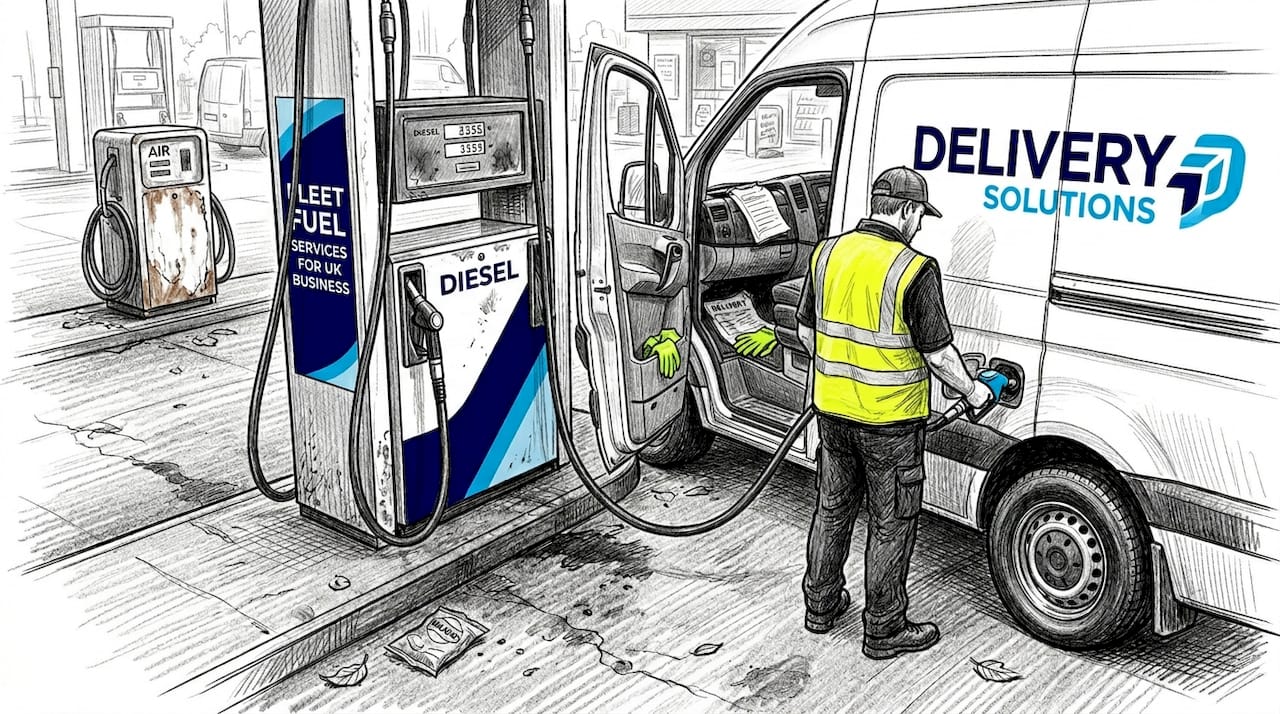
A typical delivery van covering 400 miles per week at 35mpg uses around 50 litres of diesel. At a pump price of 185p per litre, that comes to £92.50 per week per vehicle. Annualised over 50 working weeks, that is approximately £4,625 per van. For a fleet of just ten vans, you are looking at over £46,000 a year in diesel alone, before you factor in oil, tyres, or servicing.
HGV example
Heavy goods vehicles (HGVs) consume fuel at a far higher rate. A typical HGV trip of 400 miles uses around 225 litres of diesel. At a wholesale price of £1.52 per litre, that single trip costs £342 in fuel. A lorry completing three such trips per week generates over £1,000 in weekly fuel expenditure, or more than £50,000 annually. For hauliers running multiple vehicles, the numbers scale rapidly. Choosing the best fuel cards for HGVs can make a significant difference to that bottom line.
Electric vehicle example
EVs are increasingly common in light commercial fleets. HMRC's AER for Q1 2026 is 7p per mile for home charging and 15p per mile for public charging. Crucially, pure EVs are exempt from fuel benefit charges, which makes them attractive for businesses where drivers also use vehicles for personal journeys. You can also compare EV charge cards to find solutions that cover both public and workplace charging costs under a single account.
| Vehicle type | Weekly mileage | Fuel/energy cost per week | Annual estimate |
|---|---|---|---|
| Diesel van (35mpg) | 400 miles | £92.50 | £4,625 |
| HGV (typical trip) | 1,200 miles | £1,026 | £51,300 |
| Electric van (home charge, 7p/mile) | 400 miles | £28.00 | £1,400 |
| Electric van (public charge, 15p/mile) | 400 miles | £60.00 | £3,000 |
The contrast between diesel and electric running costs is striking, particularly for urban delivery routes where public charging infrastructure is improving. That said, vehicle acquisition costs and range limitations still factor into the decision for many operators.
What drives these numbers up or down? Several factors:
- Vehicle age and condition: Older engines typically consume more fuel per mile
- Route type: Stop-start urban driving burns significantly more fuel than motorway running
- Load weight: Heavier loads increase fuel consumption, particularly for vans and HGVs
- Driver behaviour: Harsh acceleration and braking can increase fuel use by up to 30%
- Fuel price volatility: Wholesale diesel prices fluctuate, making fixed-rate fuel cards valuable
Pro Tip: Track your actual cost per mile for each vehicle rather than relying on manufacturer fuel economy figures. Real-world consumption is almost always higher, and knowing your true numbers lets you spot underperforming vehicles before they become a serious drain.
How HMRC fuel rates and VAT rules shape your business claims
The rules governing what you can claim and how much are set by HMRC, and they change quarterly. Getting this right is not optional; it directly affects your tax position and VAT recovery.
HMRC Advisory Fuel Rates (AFRs) provide standard per-mile reimbursement figures for business fuel in company vehicles. They vary by engine size and fuel type. These rates are designed to cover the fuel element of a journey only, not wear and tear. If you reimburse employees at AFR rates, you do not need to report it as a taxable benefit.
The Advisory Electricity Rate for Q1 2026 sits at 7p per mile for home charging. Public charging is treated separately at 15p per mile. These figures are updated by HMRC each quarter, so it pays to check regularly.
Here is a simplified comparison of current fuel rates by vehicle type:
| Fuel type | Engine size | AFR (pence per mile) |
|---|---|---|
| Petrol | Up to 1,400cc | 13p |
| Petrol | 1,401 to 2,000cc | 15p |
| Petrol | Over 2,000cc | 23p |
| Diesel | Up to 1,600cc | 12p |
| Diesel | 1,601 to 2,000cc | 14p |
| Diesel | Over 2,000cc | 19p |
| Electric | All | 7p (home), 15p (public) |
To file a compliant fuel expense claim, follow these steps:
- Record the date, start point, destination, and business purpose of every journey
- Note the mileage for each trip using a GPS system or manual log
- Retain all fuel receipts, including the VAT amount shown
- Apply the relevant AFR to calculate the fuel element of each claim
- Use the fuel element to calculate the reclaimable VAT (divide by 1.2 to find the net, then multiply by 0.2 for the VAT)
- Submit with your VAT return or expense report, supported by your mileage log
Key compliance point: HMRC expects records to be contemporaneous. Reconstructing mileage logs at the end of the month from memory is not acceptable and creates risk during an audit.
Understanding advisory fuel rates explained in the context of your specific fleet mix helps you set accurate reimbursement policies and avoid either overpaying employees or creating taxable benefit issues. When you are ready to compare fuel card rates across providers, having this baseline knowledge ensures you can evaluate offers accurately.
Ways to reduce business fuel expenses and boost efficiency
Knowing what you spend is only half the battle. The other half is bringing those costs down without compromising your operations. The good news is that the savings available to most UK fleets are substantial.
Route optimisation is consistently the highest-impact intervention. Route optimisation reduces fuel consumption by 15 to 25%, and driver behaviour improvements can add a further 30% efficiency gain on top of that. Combined, these two levers can reduce your fuel bill by a third or more, without changing a single vehicle.
Here are the most effective strategies used by high-performing UK fleets:
- Invest in route planning software: Tools that account for traffic, road type, and vehicle load reduce unnecessary mileage and idle time
- Introduce eco-driving training: Smooth acceleration, anticipatory braking, and correct gear selection reduce fuel burn measurably
- Use a fuel card with network controls: Cards that restrict purchases to approved fuel types and locations prevent misuse and reduce leakage. Exploring fuel card network options helps you match coverage to your routes
- Set cost-per-mile targets: Benchmarking each vehicle against a target gives drivers and managers a shared performance metric
- Monitor idling time: Excessive idling is a hidden fuel drain, particularly for HGVs with refrigeration units or vehicles waiting at loading bays
- Review tyre pressures regularly: Under-inflated tyres increase rolling resistance and fuel consumption by 2 to 3% per vehicle
Fuel cost management tips go beyond simple purchasing decisions. The most effective approach combines technology, driver engagement, and regular data review. If you run HGVs, integrating HGV telematics with your fuel card data gives you a complete picture of where fuel is going and why.
Pro Tip: Set a monthly review date to compare actual fuel cost per mile against your benchmark. Even a 1p per mile improvement across a fleet of 20 vehicles covering 2,000 miles per month saves £400 monthly, or nearly £5,000 per year.
A practical perspective: why business fuel management is about more than receipts
Most businesses approach fuel expenses as a compliance task. Keep the receipts, fill in the forms, submit the claim. Done. But that mindset leaves serious money on the table.
The businesses we see managing fuel most effectively treat it as a profit lever. They know their cost per mile for each vehicle. They track it monthly. They compare it against industry benchmarks. And they act on what the data tells them. Fuel is the largest variable cost in road freight, with fuel duty alone sitting at 52.95p per litre and VAT at 20% on top of that (reclaimable for VAT-registered businesses). That is a substantial tax burden, and every penny of reclaimable VAT that goes unclaimed is profit walking out the door.
The uncomfortable truth is that most fleets still do not benchmark their fuel spend. They know roughly what they spend, but they do not know whether that figure is competitive, whether individual vehicles are underperforming, or whether their reimbursement rates are accurate. That gap between knowing and acting is where the real savings hide.
Regularly revisiting your fuel card contracts, your AFR calculations, and your route efficiency is not admin overhead. It is a management discipline that compounds over time. A fleet that reduces its fuel cost per mile by 5% year on year does not just save money in year one. It builds a structural cost advantage that competitors without that discipline cannot easily match.
The practical approach to real-world cost management starts with one simple commitment: measure cost per mile, not just total spend. Total spend tells you how much you paid. Cost per mile tells you how efficiently you are operating. That is the number worth optimising.
Fuel card solutions to simplify and save
Managing fuel expenses manually across a fleet is time-consuming, error-prone, and leaves you exposed to compliance risk. The right fuel card changes all of that, automating the data capture that makes VAT recovery straightforward and giving you the reporting tools to benchmark performance.

At FuelCard Store, we connect UK fleet operators, couriers, hauliers, and tradespeople with fuel card solutions tailored to their specific needs. Whether you want to know where to use your fuel card across the UK's forecourt network, need strategies for cutting your fuel bill through smarter purchasing, or want to explore prepaid fuel card options for tighter budget control, we offer free, impartial comparisons with no obligation to apply. Savings of up to 20p per litre on diesel are available through the right card. The comparison takes minutes and costs nothing.
Frequently asked questions
How do I separate business and personal fuel use for HMRC?
Keep detailed mileage logs and receipts for every journey, and apply HMRC Advisory Fuel Rates to claim only the business miles driven in company vehicles.
Can I reclaim VAT on all types of fuel expenses?
You can reclaim VAT on the business portion of fuel, provided you hold valid VAT receipts and accurate mileage logs. VAT is reclaimable on the business fuel portion using AFRs to calculate the correct split.
What is the average fuel cost for a delivery van per year in the UK?
A van covering 400 miles per week at 35mpg costs approximately £4,625 per year in diesel at 185p per litre, though actual costs vary with route type and fuel prices.
Are electric vehicle charging expenses claimable as business fuel expenses?
Yes. HMRC's AER of 7p per mile for home charging applies for Q1 2026, and pure EVs are exempt from fuel benefit charges, making them particularly tax-efficient for business use.